Thursday, April 14, 2011

What is in a name? Mango

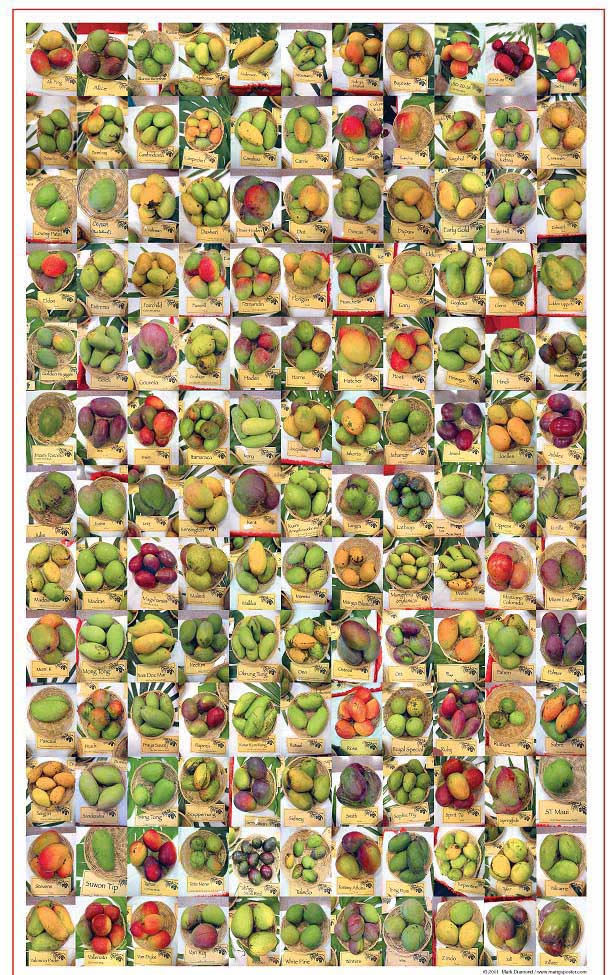
One of my friends recently asked me about my dream farm. While I'm not exactly sure what I would grow if I had my own farm, I know I would definitely be growing mango. Mangoes, Mangifera indica L., are grown and eaten around the world. It seems like there are almost as many names for 'mango' as there are different varieties.

Source


Names for Mangifera indica L.
SYNONYM(S) : Mangifera domestica Gaertn.
ARABIC :            مانجا      Manja,       Mangô.
ASSAMESE : Ghariyam.
BENGALI : Aama (Aam).
BURMESE : Thayeq dhì (Tharyetthi), Thayeq (Thayet).
CHINESE : Mang guo, Mang guo.
CZECH :   Mangovník indický.

DANISH : Mango, Mangotræ.
DUTCH : Manga, Mangga, Manja, Mangoestanboom, Mangostanboom.
ENGLISH : Indian mango, Mango, Mango tree , Mango-tree.
FINNISH : Mango, Mangopuu.
FRENCH : Mangue, Manguier.
GERMAN : Indischer Mangobaum, Mango , Mangofrucht, Mangobaum, Mangopalme.
GREEK :  Μάγκο   Magko,   Μάνγκο   Mangko.

HAUSA : Mangoro (Nigeria).
HEBREW : .
HINDI : Aam.
ITALIAN : Mango (fruit), Mango (tree).
JAPANESE : Mangoo, Mangou.
KHMER : Svaay.
KOREAN : Mang ko.
LAOTIAN : Mak mouang, Mwàngx.
MALAY : Ampelam, Mangga, Mangga (Indonesia), Mempelam.
NEPALESE : Aanpa, Amacura.
NORWEGIAN : Mango.
PERSIAN :         انبه        
POLISH :  Mango indyjskie.

PORTUGUESE : Manga, Mangueira.
RUSSIAN :   Манго    Mango.
SINHALESE : Etamba.
SLOVAKIAN :  Mangovník indický.

SPANISH : Mango (fruit), Mango (tree).
SWAHILI : Mwembe.
SWEDISH : Mango, Mango-arter.
TAGALOG : Mangang kalabau, Mangga.
TELUGU : Amramu.
THAI : Mamuang (Ma muang, Mak mouang).
URDU : Aam, Amba.
VISAYAN : Mangga.
VIETNAMESE : Xoài.


Monday, April 11, 2011

Topics in Tapioca


Cassava, Manihot esculenta Crantz, is a tropical crop grown for its bulky, starchy roots. Cassava originated in Paraguay and Brazil. It is a perennial woody shrub. Cassava is major source of low-cost carbohydrates for many people living in the humid topics. Cassava is one of the only crops grown in Africa produced in all ecological zones. Additionally, the crop is attractive to farmers because there is minimal or no requirement forfertilizer, a minimal weeding burden, and tolerance to drought and poor soils. Today, no wild forms of the species Manihot esculenta are known. Cassava is a diploid (2n=36).

Cassava is propagated vegetatively as clones, meaning that portions of mature plant stem are planted instead of seed. There is a wide range in the production yields of fresh root, reaching 90 tons/hectare while the world average is 9.8 t/ha due to much lower yields in subsistence agricultural systems.  

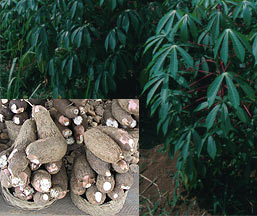
Photo of a man with cassava roots from USAID


Roots are prepared similarly to potato; they can be peeled and baked, boiled, or fried. Cooking cassava is important because the plant contains potentially toxic concentrations of compounds called cyanogenic glucosides that are rendered innocuous through cooking. In Africa, the roots are commonly fermented and then milled into flour or used to produce alcoholic beverages. Leaves are also consumed; young tender leaves are used as a leafy green vegetable and are prepared in a way similar to spinach. Proteins in the leaves have been found to equal in quality to the protein in egg. In addition to human consumption, unpeeled roots are dried and grated for animal feed. Also, cassava is used in industrial processing to make products including textiles, adhesives, high fructose syrup and paper.

In 2009, the FAO estimates that about 241 million tons of cassava were produced. The top producers of cassava were Thailand, Brazil and Indonesia.

countries
item
element
2008
2009
World + (Total)
Cassava
Production (tonnes)
232462874
240989481
Thailand
Cassava
Production (tonnes)
25155797
30088024
Brazil
Cassava
Production (tonnes)
26703039
26030969
Indonesia
Cassava
Production (tonnes)
21593052
22039148
Angola
Cassava
Production (tonnes)
10057375
12827580
Ghana
Cassava
Production (tonnes)
11351100
12230600
India
Cassava
Production (tonnes)
9056000
9623000
Viet Nam
Cassava
Production (tonnes)
9395800
8556900
Uganda
Cassava
Production (tonnes)
5072000
5179000
China
Cassava
Production (tonnes)
4411573
4511573
Cambodia
Cassava
Production (tonnes)
3676232
3497000
Source: FAOSTAT

Cassava is important to the diet of over one billion people and is the world’s fourth most important staple crop after rice, wheat and maize (corn). Given the widespread cultivation of cassava and its tolerance to harsh conditions, it has been recognized as essential to food security for millions.

Agnes Dherbeys for The New York Times
In a move that could impact food security, China has recently started using cassava as a biofuel, resulting in higher prices for cassava and expanded cultivation in countries like Thailand. Below is a NYTimes article about this development.


Friday, April 8, 2011

The many names of Cassava

The next crop to be profiled will be Cassava. Cassava, Manihot esculenta, is also known as Tapioca and Manioc in English. It's important worldwide as a food crop, a feed crop for livestock, and, increasingly, as a biofuel crop. Below are some of the common names for M. esculenta (Source).

Photo from the Cassava Genome Project


Manihot esculenta Crantz
 
SYNONYM(S) : Janipha manihot H.B.K. , Jatropha janipha Lour., Jatropha loureiri Steud., Jatropha manihot L., Manihot loureiri Pohl, Manihot manihot (L.) Cockerell, Manihot melanobasis Muell. Arg. 

CHINESE : Mu shu.
DANISH : Maniok.
DUTCH : Cassave, Maniok.
ENGLISH : Cassava, Manioc, Tapioca, Tapioca plant.
FINNISH : Maniokki, Kassava.
FRENCH : Manioc, Tapioca.
GERMAN : Cassava, Maniok.
HINDI : Marachini, Mara valle kilangu, Maravalli, Simla aloo, Simul alu.
ITALIAN : Manioca.
JAPANESE : Imo noki, Kyassaba, Maniokku, Tapioka noki.
KANNADA : Maragenasu.
MALAY : Ubi kayu, Kaspe (Indonesia).
MALAYALAM : Kappa, Marakizhangu.
NEPALESE : Simal tarul.
PORTUGUESE : Aipim (Brazil), Macaxeira (Brazil), Mandioca (Brazil), Maniba (Brazil).
SANSKRIT : Karrapendalamu.
SPANISH : Caxamote (Guatemala), Guacamote (Ecuador), Farinha, Huacamote (Ecuador), Mandioca (Paraguay), Mañoco (Puerto Rico), Yuca (Lat. America).
SWAHILI : Mhogo.
SWEDISH : Maniok.
TAGALOG : Kamoteng kahoy.
TAMIL : Maravallikizhangu.
TELUGU : Karrapendalamu.
THAI : Mansampalang (Man sam parang, Mun sumpalung).
VIETNAMESE : Bosan hot.

There may be a sweet form / subspecies / species that ought to be recognized. In which case some of the above botanical and common names may apply to it. Some authors place the sweet cassava under M. aipi and the bitter cassava under M. utilissima. Many countries recognize the two types and it seems wise to do so from the culinary and medicinal view points.  Taxonomists need to address this perhaps?


Monday, April 4, 2011

Where are the eggplant?


The other day, I went to the grocery store to buy an eggplant for a dish and I couldn't find them. When I asked one of the guys in the produce section if they had any eggplant, he told me that he hadn't seen any in about a month. A quick Google search informed me that the winter eggplant crop has largely been lost due to frost. About half of the U.S. winter eggplant supply comes from Mexico, which experienced their first freeze since 1957 in February affecting most of the country’s key eggplant-growing regions. The other half of US supply is grown in Florida where farmers also suffered heavy losses due to frosts in December and January. The shortage should end soon due to harvest of Canadian greenhouse-grown eggplants and another crop of Florida-grown eggplant.  

Eggplant wasn’t the only crop affected by poor weather. The unusual freezes in Florida and Mexico have also affected the supply and availability of green peppers, tomatoes, yellow squash and zucchini. “Produce experts say Almost the entire crop of green beans was lost because of the freeze; and zucchini took an 80 to 90-percent hit. Cucumbers and green pepper crops suffered a nearly 80-percent loss.”

There may be a shortage of eggplant at the grocery store, but there's no shortage in my affection for eggplant. Here are some interesting facts about Solanum melongena L.(eggplant). 


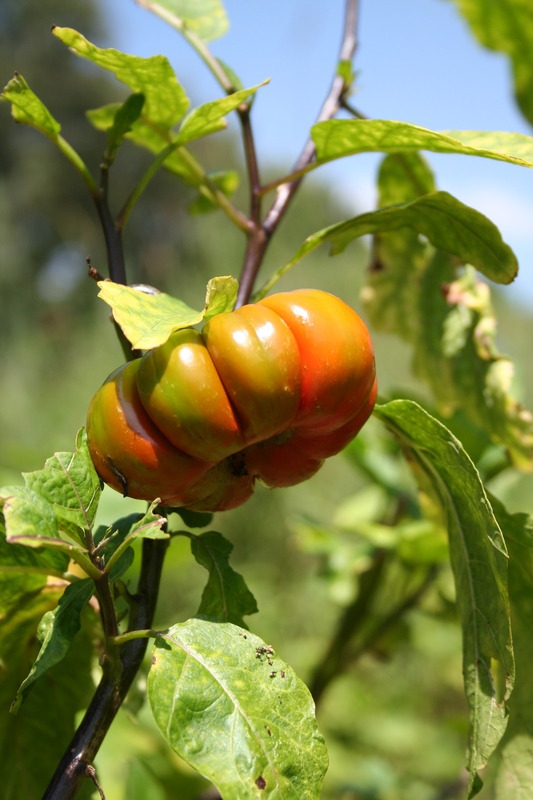
- Eggplant is a common name that is used for three closely related species belonging to the genus Solanum; those three species are Solanum melongena L. (this is the species that we’re probably most familiar with and includes varieties like Thai eggplant. Brinjal eggplant, and aubergine), Solanum macrocarpon L. (gboma eggplant), and Solanum aethiopicum L. (scarlet eggplant) (Source).

- S. macrocarpon and S. aethiopicum were domesticated in Africa and cultivation of these species is primary limited to Africa (Source). 
 

   Scarlet eggplant (S. aethiopicum)- Source
    
Scarlet eggplant (S. aethiopicum)- Source


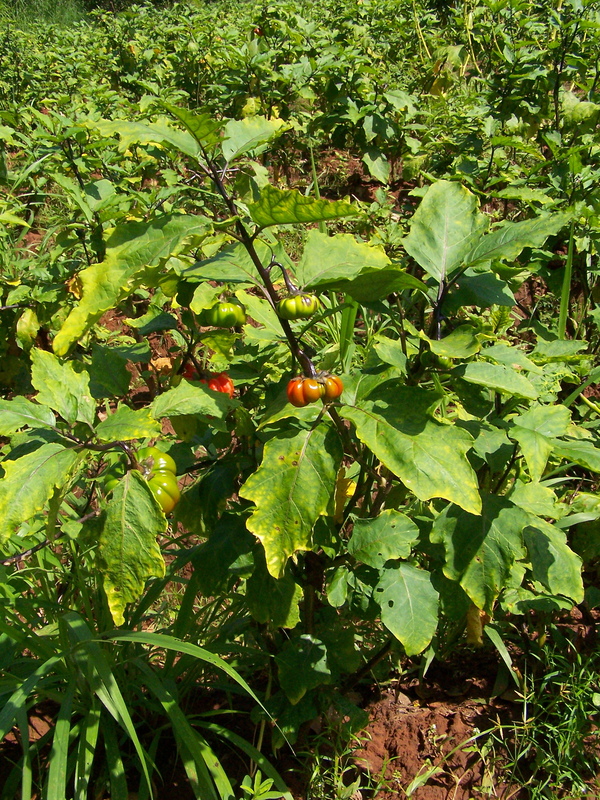
Gboma eggplant (S. macrocarpon) - Source
 

 - These two species do not have the diversity of size and shape that aubergine has, but they do have a diversity of color.


Gboma eggplant (S. macrocarpon) - Source


- Aubergine, S. melongena, was domesticated in India and southeast China (Source). In the United States, the word 'eggplant' refers to this species (As such, the rest of the eggplant "fun facts" refer to S. melongena).
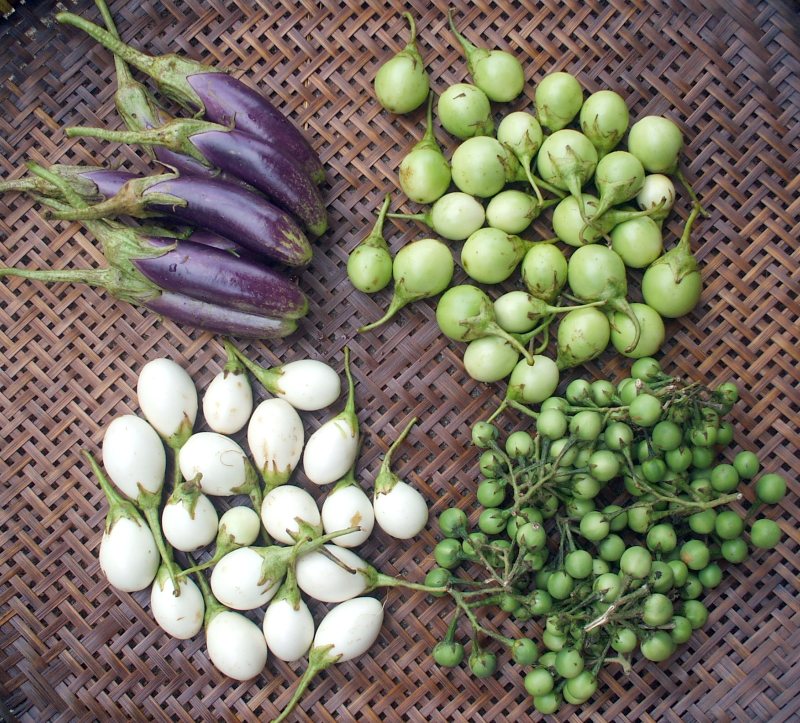
Aubergine (S. melongena) include a wide variety of colors and shapes - Source

I was unable to find an estimate of how many varieties of eggplant exist, but there are a lot - Source


- Cultivation of eggplant spread to the Mediterranean in the seventh century as a result of the Arab conquests in South Asia (Source).

- Eggplant received its name from Europeans who were most familiar with a variety with white, egg-shaped fruit (Source).

- Eggplant is closely related to the tomato and potato; they are all members of the genus Solanum.

- Thomas Jefferson is thought to have introduced the eggplant to the United States. He grew the vegetable in his garden at Monticello.

- 83 percent of world eggplant production comes from India and China (2010 stat)


Friday, April 1, 2011

Eggplant Excitement

I've been working on an eggplant entry for a couple days and I keep getting distracted by interesting articles about the diversity of plants that are called eggplant. While I finish up this more substantive entry on eggplant, I thought I'd share this list of the word for "eggplant" in a bunch of different languages. (Source)

Photo from the Ag Marketing Resource Center

SYNONYM(S) : Solanum melongena L. var. esculentum (Dunal) Nees, Solanum edule Schumann & Thonning , Solanum esculentum Dunal
AFRIKAANS :  Eiervrug.
ARABIC :  باذنجان   Bādhimjān الباذنجان    Badinjan (al baðinjān).
ARMENIAN :  բադրիջան  Badriǰan.
BENGALI :  বেগুন   Begun,  বার্তাকু  Baingan.
BULGARIAN :  Патладжан  Patladzsan . 
BURMESE : Kayan.
CATALAN :   Albargina, Alberginiera.
CHINESE : Qie, 茄子  Qie zi, Ai gua / ngai gwa (Cantonese name).
CROATIAN :  Патлиџан   Patlidžan .
CZECH :  Lilek, Lilek baklažán, Lilek vejcoplodý.
DANISH :  Ægplante, Aubergine.
DUTCH : Aubergine, Eierplant, Eiervrucht, Melanzaanappel.
ENGLISH : Aubergine (UK.), Eggplant (USA), Brinjal (India), Large-fruited eggplant, Melongen (Caribbean Trinidad).
ESTONIAN :  Baklažaan.
FINNISH : Aubergiini, Munahedelmä, Munakoiso.
FRENCH : Albergínia (Catalan), Aubergine, Bringelle, Mélongène.
GERMAN : Eierfrucht, Eierpflanz.
GREEK :    Μελιτζάνα  Melitzana.
GUJARATI :   રીંગણ  Ringan, Ringna, વેંગણ  Vengan. 
HEBREW :  חציל  Hatzil, חָצִיל  Hatzil.
HINDI :  औबरजाइन्स  Aubarajā'insa,  बैंगन    Baigan, Baijani, बैंगन  Baingan.  
HUNGARIAN : Padlizsán , Padlizsános, Tojàsgyümölcs.
ICELANDIC :  Eggaldinjurt.
ITALIAN :  Maranziana, Melanzana, Mulignana, Petonciano, Petrociana.
JAPANESE :  ダ イマルナス  Daimaru nasu,  丸なす Daimaru nasu, 茄子  Daimaru nasu, エッ グプラント Eggupuranto,  茄子 Nasu, なす Nasu, ナス Nasu.
KANNADA :  Badanekai.
KASHMIRI :  वाँगुन्.
KHMER : Trâb vèèng, Trâb put lonhoong.
KOREAN : 가지.
LAOTIAN : Khüa ham maaz, Khüa hlèèz, Khüa poom.
LITHUANIAN :  Baklažanas.
MACEDONIAN :  Патлиџан Patlidžan.
MALAGASY :  Baranjely.
MALAY : Terong, Terung (Indonesia), Encung (Indonesia), Tiung (Sumatra).
MALAYALAM :  Valutananna, Vazhudhanaikkai, വഴുതന Vazhuthana, Vazhuthananga.
MARATHI :  वांगे Vangi.
NEPALI :  भन्टा   Bhanta.
NORWEGIAN :  Aubergine, Eggfrukt.
ORIYA :  Baigana.
PERSIAN :   بادنجان   Bâdenjân,   بادنجان    Bâdinjân.
POLISH :  Bakłazan, Gruszka miłosna, Oberżyna, Oberżynowy.
PORTUGUESE : Beringela.
PUNJABI :  ਵੈੰਗਣ , ਬੈਂਗਨ   Baingana.
ROMANIAN : Patlagea vanata, Pătlăgea vânătă, Pătlăgele vinete , Vanata, Vânătă, Vinete.
RUSSIAN :  Баклажан    Baklazhan (Baklažan).
SANSKRIT :  Bhantaki , Nattingan, वातिगगम  Vaatigagama  (vātiga-gama),  वृन्ताकम्  ,Vatinganah, Varttaka.
SERBIAN :   Плави патлиџан  Plavi patlidžan Патлиџан    Patlidžan.
SLOVENIAN : Jajčevec, Patlidžan jajcevec.
SLOVAK : Baklažán, Baklažány (plur.)
SPANISH : Berenjena, Albergínia (Catalan).
SWAHILI :  Mbilingani, Mbiringanya.
SWEDISH :  Äggplanta, Äggört, Aubergine.
TAGALOG : Talong.
TAMIL :    Kathiri , Kathirikai,  கத்திரி   Kattiri, கத்தரி .
TELUGU :  వంగ  Vanga,  వంకాయ   Vankāya,  బ్రింజాల్ ,  ఎగ్గ్ ప్లాంట్ ,  ఆబర్జీన్ ,  వార్తాకము.
THAI :  มะเขือ  Makhua, มะเขือยาว  Ma khuea yao (Ma khuea yaao, Makhua yao, Makhua yow) , Makhua chan,  มะเขือขาว   Ma khuea khao  (Má kĕua kăao, Makhua khao, Ma khua kow, Ma kuah kow).
TURKISH :   پاتلیجان   (patlıcan),  Patlıcan.
UKRAINIAN :  Баклажани.
URDU :  بینگن  Baingan.
VIETNAMESE : Cà tim, Cà bat, Cà tin, Quả cà.
VISAYAN : Bringhinas, Tarong.