Some History
Mango, Mangifera indica, is believed to have been domesticated about 4000 years ago around Northeastern India and Southeast Asia. Portuguese traders are largely responsible for introducing mangoes to Africa and Brazil in the 16th century.
 |
| Mango tree |
Botany
Mangifera indica L. is a member of the plant family, Anacardiaceae, which contains a number of highly poisonous plants. Sap from mango trees is a potent skin irritant and can cause blistering of the skin.
Mango trees are evergreens that can reach heights of 90ft (~27.5 meters) and widths of 80 ft (~24.5m). During flowering, mature trees are covered in hundreds of small white flowers, about ¼ inch wide when open. Most flowers are imperfect and function as males to provide pollen for pollination, while the rest are perfect flowers, containing both female and male plant reproductive structures. The perfect flowers are the ones that can set fruit.
 |
| Source |
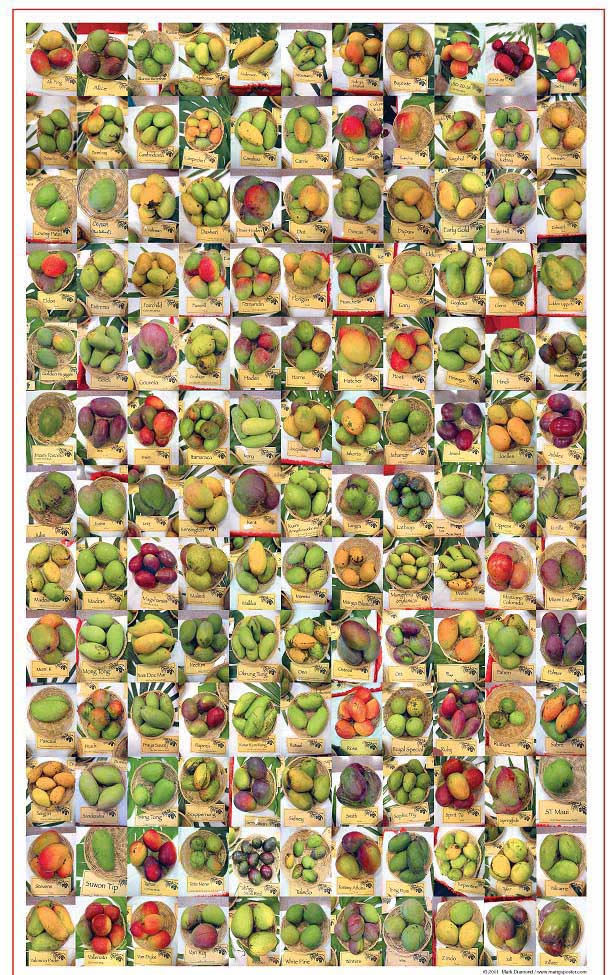
Fruit can be round, ovate, or obovate and can weigh in the range of ¼ pound to 3 pounds (.11-1.36kg). Immature fruit has green skin that turns yellow, red, orange, purple or some combination of those colors as it matures. The fruit contains a single seed that is flattened and sticks to the fruit flesh surrounding it.
Production
In 2008, the top mango producers (according to the FAO) were India, China and Thailand. In addition to being the largest producer of mangoes, India also has over 1,000 different varieties and mango is sometimes regarded as the "king of fruits."
| countries | item | element | 2008 | |
| World + (Total) | Mangoes, mangosteens, guavas | Production (tonnes) | 34889014 | |
| 1 | India | Mangoes, mangosteens, guavas | Production (tonnes) | 13649400 |
| 2 | China | Mangoes, mangosteens, guavas | Production (tonnes) | 3976716 |
| 3 | Thailand | Mangoes, mangosteens, guavas | Production (tonnes) | 2374165 |
| 4 | Indonesia | Mangoes, mangosteens, guavas | Production (tonnes) | 2013123 |
| 5 | Mexico | Mangoes, mangosteens, guavas | Production (tonnes) | 1855359 |
| 6 | Pakistan | Mangoes, mangosteens, guavas | Production (tonnes) | 1753686 |
| 7 | Brazil | Mangoes, mangosteens, guavas | Production (tonnes) | 1154649 |
| 8 | Philippines | Mangoes, mangosteens, guavas | Production (tonnes) | 884011 |
| 9 | Bangladesh | Mangoes, mangosteens, guavas | Production (tonnes) | 802750 |
| 10 | Nigeria | Mangoes, mangosteens, guavas | Production (tonnes) | 734000 |
 |
| Source |
Importance
Beyond being delicious, mango is a good source of Vitamin A. Vitamin A deficiency is the leading cause of preventable blindness in children and is especially problematic in Africa and Southeast Asia, regions with mangoes.
Vitamin A content (Source) |
| Level | ug retinol equivalent/kg | Crops |
| Medium | <500 ug | guava, kumquat, mandarin |
| High | <4000 ug | apricot, loquat, orange-fleshed melon, papaya, persimmon |
| Red pepper | 6000 ug | |
| Mango | 12500 ug |
Nutrition
“Raw mango consists of about 81.7% water, 17% carbohydrate, 0.5% protein, 0.3% fat, and 0.5% ash. A 100 g (3.5 oz) serving of raw mango has 65 calories and about half the vitamin C found in oranges. Mango contains more vitamin A than most fruits.” (Crop Master Knowledge).
 |
| Mangoes of different shapes and colors - Source |

 Mangô.
 Thayeq dhì (Tharyetthi), Thayeq (Thayet).
 Mang guo,
 .
.


 Mangoo,
  Mangou.


 Aanpa,
  Amacura.
 Mamuang (Ma muang, Mak mouang).

